
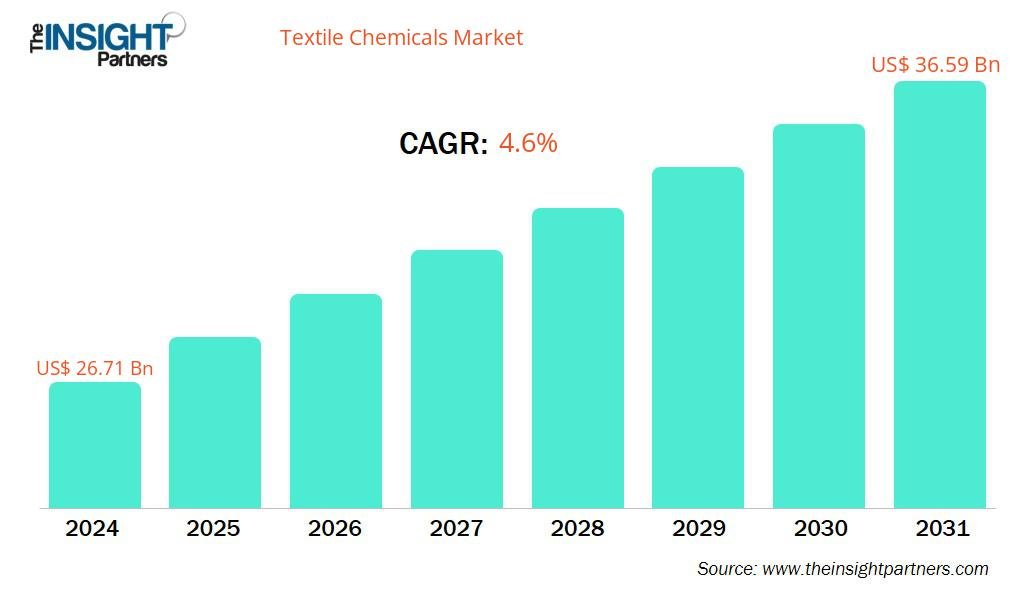
The global Textile Chemicals Market is expanding as apparel brands, fabric mills, and industrial textile producers shift toward functional performance finishes, low-water dyeing processes, and non-toxic chemical formulations. Growth is supported by stricter environmental regulations, rising technical textile consumption, synthetic fiber expansion, and brand-level restricted substance compliance.
The Textile Chemicals Market size is expected to reach US$ 36.59 billion by 2031. The market is anticipated to register a CAGR of 4.6% during 2025–2031.
What is driving the market?
Demand for value-added performance fabrics, sustainability mandates, and the expansion of technical textiles are the principal growth drivers. Textile processors are increasingly required to deliver specialized fabric properties such as moisture management, antimicrobial protection, flame retardancy, UV resistance, and durable water repellency while reducing water and energy consumption during wet processing. Apparel brands, sportswear manufacturers, and automotive suppliers are seeking chemical formulations that enhance durability and aesthetics without introducing hazardous residues.
The industry is moving beyond conventional commodity auxiliaries toward bio-based, enzymatic, and fluorine-free chemistry. Suppliers are investing in low-VOC finishes, salt-free reactive dyeing systems, and non-PFAS water repellents designed to meet strict wastewater and consumer safety standards. Volatile petrochemical feedstock prices, high R&D costs for green reformulations, and fragmented effluent treatment compliance among smaller mills remain important constraints.
Which region leads?
Asia Pacific leads the market, accounting for an estimated 57%–59% share in 2025, and is also the fastest-growing region with a projected CAGR of 5.5%–5.9%. Growth is supported by massive textile and apparel manufacturing capacity, synthetic fiber production, export demand, and government-backed textile infrastructure programs. China and India present significant opportunities as high-volume dyeing and finishing clusters modernize to meet global brand sustainability audits and domestic technical textile demand.
Europe holds an estimated 19%–21% share, supported by stringent chemical safety regulations, advanced technical textile manufacturing, and leadership in sustainable chemistry. North America accounts for approximately 14%–16%, with demand driven by industrial nonwovens, protective workwear, automotive textiles, and rapid state-level transitions away from fluorinated finishes.
Which segment leads?
Coating & Sizing Chemicals is the leading product segment, representing an estimated 41%–50% of market revenue in 2025. Its position is supported by widespread use in yarn preparation, fabric strength enhancement, and functional surface coatings across apparel and industrial fabrics. Finishing Agents is identified as a high-growth product segment, expanding at a CAGR of 5.1%–5.6% through 2033 as demand rises for non-PFAS repellents, bio-based softeners, and antimicrobial treatments.
By application, Apparel leads with an estimated 44%–47% share in 2025, reflecting continuous global demand for everyday clothing, activewear, and fast-fashion processing. Technical Textiles (spanning automotive, medical, protective, and construction fabrics) represents the fastest-growing application outlet, driven by specialized functional coating and durability requirements.
Which companies are prominent?
The market features Archroma, BASF SE, The Dow Chemical Company, DyStar Group, Huntsman Corporation, CHT Group, Rudolf GmbH, Tanatex Chemicals B.V., Wacker Chemie AG, and Evonik Industries as prominent market participants.
These companies compete across dyestuffs, pretreatment enzymes, silicone softeners, performance finishing agents, and specialty polymers. Strategic differentiation increasingly depends on ZDHC (Zero Discharge of Hazardous Chemicals) compliance, water- and energy-saving process formulations, technical mill support, and the ability to commercialize bio-based or PFAS-free alternatives at scale. This list reflects the competitive landscape rather than a revenue-ranked market-share table.
What is changing in 2026?
The market is shifting rapidly from voluntary eco-friendly claims toward mandatory chemical transparency and PFAS-free compliance. Regulatory crackdowns on per- and polyfluoroalkyl substances (PFAS) across the European Union and U.S. states, alongside stricter wastewater enforcement in Asian manufacturing hubs, are forcing mills to phase out legacy fluorinated water repellents and formaldehyde-based resins.
Manufacturers are accelerating the rollout of bio-based auxiliaries, enzymatic scouring agents, and digital textile printing inks that drastically reduce water consumption and chemical runoff. Brand procurement decisions are increasingly tied to verified chemical inventory tracking, Bluesign and OEKO-TEX certifications, and compatibility with recycled polyester and blended fiber processing.
What are the major investment opportunities?
The strongest opportunities lie in PFAS-free functional finishes, bio-based and enzymatic processing auxiliaries, digital printing chemistries, and textile-to-textile recycling additives. Investment in fluorine-free water and oil repellents offers immediate commercial upside as global apparel and outdoor brands reformulate entire product lines to meet regulatory deadlines.
Additional opportunities include low-liquor-ratio dyeing systems, salt-free reactive dyes, and specialized chemical formulations engineered for recycled synthetic fibers and blended fabrics, which often suffer from dyeability and strength loss during mechanical or chemical reprocessing.
Asia Pacific offers attractive expansion potential through local technical service centers and specialty formulation plants serving export-oriented textile parks in India, Vietnam, and China. Investors should prioritize chemical platforms that deliver measurable water and energy savings for mills while maintaining cost parity with conventional petrochemical auxiliaries.
Future Outlook
Through 2031, the Textile Chemicals Market will evolve from volume-driven commodity supply into a compliance- and performance-led specialty sector. As circular textile mandates gain traction globally, chemical suppliers will play a critical role in enabling fiber-to-fiber recycling developing removable coatings, recyclable sizing agents, and purification chemistries that allow post-consumer garments to be reprocessed into virgin-grade fibers. Over the next decade, market leadership will belong to innovators that seamlessly combine high-durability fabric performance with verifiable low-carbon, closed-loop chemistry.
- Pune Maharashtra India
- Do not display my email
- https://www.theinsightpartners.com/reports/textile-chemicals-market